Worried About Your Teen? A Parent's Guide to Getting Help


Something has changed. They're in their room more. The friendships have gone quiet, or the mood has gone sharp, or the kid who used to tell you everything now answers in single syllables.
And you're stuck on the question every parent gets stuck on: is this just being fifteen, or is this something?
You won't find certainty in this article. What you'll find is a way to tell the difference more often than not, a way to raise it without triggering a standoff, and a clear map of where help actually is.
Ordinary teenage turbulence — or something more?
Adolescence is supposed to involve moodiness, pulling away from parents, sleeping oddly, and caring enormously about things you find baffling. That's development, not illness.
What shifts the picture is duration, pervasiveness and function. Not one bad fortnight, but weeks. Not grumpy at home, but flat everywhere. Not "off school Monday", but no longer doing the things they love.
Signs worth paying attention to:
- Low, irritable or anxious mood most days for several weeks
- Withdrawing from friends, sport, or activities they used to enjoy
- A real drop in school attendance or performance
- Sleep or appetite that has changed substantially and stayed changed
- Persistent physical complaints — stomach aches, headaches — with no clear cause
- New secrecy, or a sudden change in friendship group
- Signs of self-harm, or talk about not wanting to be here
- Alcohol or other drug use that's escalating
That second-to-last one is the one nobody wants to read. If your child has self-harmed, or has spoken about suicide, take it seriously and act now — call Lifeline on 13 11 14, or 000 if they are in immediate danger. Asking a young person directly whether they're thinking about suicide does not plant the idea. It gives them permission to answer.
How to start the conversation
The conversation usually fails when it happens face-to-face, with eye contact, at the kitchen table, opening with "we need to talk."
It usually works better in a car, on a walk, doing the dishes — side by side, where nobody has to hold a gaze. Try leading with what you've noticed rather than what you've concluded: "I've noticed you haven't been seeing Ash much lately. How are you going?" beats "I think you're depressed."
Then the hard part: stop talking. Let the silence sit. Resist fixing, minimising ("everyone feels like that sometimes"), or leaping to solutions. Most young people test the water with something small first to see how you react to it.
If they don't want to talk to you, that isn't failure. It's fairly standard. What matters is that they know the door is open, and that you offer them someone else — a GP, a school wellbeing coordinator, an aunt, a counsellor.
Where help actually is
The pathways in Victoria, roughly in order of how easy they are to reach:
School wellbeing teams are free, already know your child, and are underused. Start there if the difficulties show up at school.
Your GP can assess, treat, refer, and write a Mental Health Treatment Plan for rebated psychology sessions. Book a long appointment.
headspace provides free or low-cost support for 12 to 25 year olds, and young people can often self-refer without a parent.
Child and youth mental health services in the public system exist for young people who are seriously affected. They're free, and access is usually via GP or triage. The Department of Health outlines how the state's services are organised in its overview of Victoria's mental health services.
Private counselling, psychology or Nurse Practitioner care fills the gap in between — usually with the shortest wait.
What a first appointment with us looks like
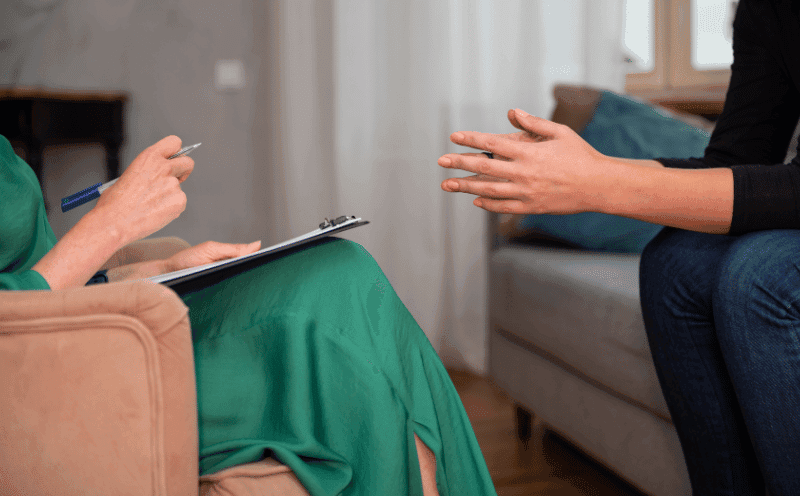
Nobody is put on the spot. We usually spend time with your young person on their own, and time with you, and we're explicit up front about what stays confidential and what doesn't. Safety is always the exception, and they'll know that before they say anything.
There's no diagnosis on day one, no pressure toward medication, and no assumption that a teenager who doesn't want to be there is being difficult. Often they've been dragged in. We've met a lot of teenagers in that chair, and it usually thaws.
Our adolescent counselling is for young people 12 and up, at our Gisborne and Woodend rooms or via Telehealth. It's neuroaffirming, developmentally attuned, and works alongside families rather than around them.
What helps at home, meanwhile
You have more influence than it feels like at 7pm on a Tuesday.
Protect sleep — teenagers need eight to ten hours, and phones in bedrooms quietly steal them. Keep meals and routine steady. Keep them connected to at least one thing outside the house. Don't withdraw affection when they withdraw from you. And look after yourself: worried parents run on empty, and your steadiness is the thing they're borrowing.
It also helps to know that anxiety in young people is extremely common and very treatable, and that autism and mental health frequently intersect — an undiagnosed autistic or ADHD teenager is often an exhausted, anxious one.
If you take one thing from this
You do not have to be certain that something is wrong before you ask for help. "I'm not sure, but I'm worried" is a completely legitimate reason to book an appointment, and it's how most parents arrive.
Getting it checked early is a small cost. Waiting is sometimes a large one.
You can refer your teen yourself — no GP referral or Mental Health Care Plan required — and Medicare rebates apply. See our fees, our FAQ, or just get in touch. We're currently accepting new referrals.

Lindsay Moncrieff, NP
Mental Health Nurse Practitioner
Master of Mental Health Nursing (Nurse Practitioner)
Lindsay is a Mental Health Nurse Practitioner with over 15 years' experience supporting teens and adults. She practises from Gisborne and Woodend, and via Telehealth.
Registered with the Australian Health Practitioner Regulation Agency (AHPRA) — registration no. 0001675831.